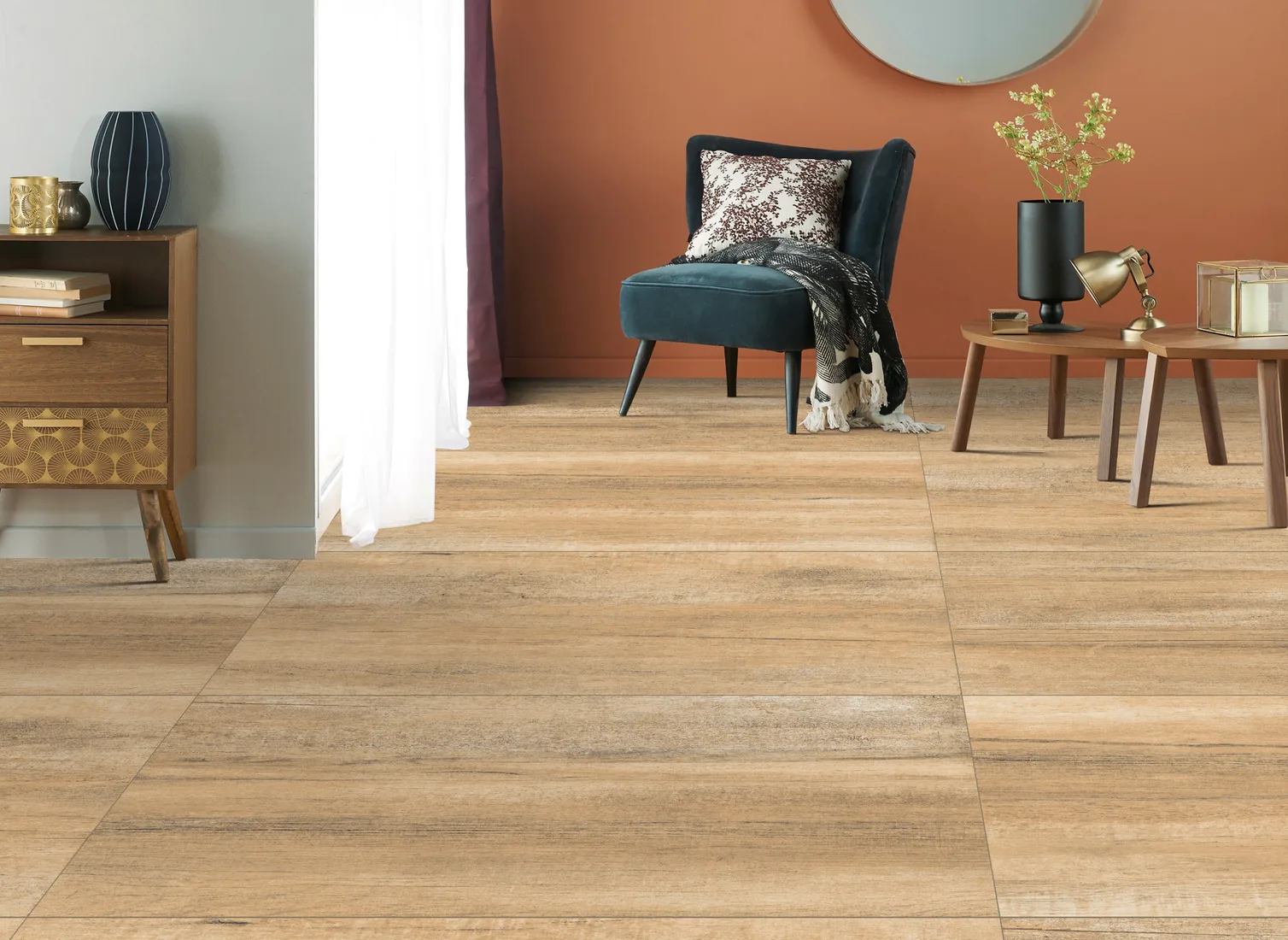
A kitchen floor takes spilled oil, dropped pans, heat, water and constant footfall. The right tile makes this invisible. The wrong one shows every stain and scratch or, worse, causes slips.
Ceramic floor tiles
Ceramic floor tiles have a fired clay body with a glazed surface. They are economical, easy to cut and available in plenty of designs. For a lightly used domestic kitchen they perform well, provided the surface is matt and the tile is rated for floors.
The weak point is a chipped glaze, which exposes a more porous body. Lumina Tile's ceramic floor tiles run from 30 × 30 cm to 60 × 60 cm in 7 to 12 mm.
Porcelain floor tiles
Porcelain is the benchmark for kitchens. Water absorption is 0.5 percent or less, so oil and liquids stay on the surface. It resists scratches and heat and supports bigger formats. Sizes such as 60 × 60 cm (600 × 600 mm) and 60 × 120 cm give a clean, low-joint look.
Full body porcelain
With colour right through the tile, scuffs and chips are barely visible. It is a strong choice for commercial kitchens, canteens and busy family homes. Designs tend to be more uniform, with a stone or concrete effect.
Textured and R-rated tiles
Kitchens are slippery places. A textured surface such as Carving, Sugar, Rustic or Lapato offers grip while still being cleanable. For commercial kitchens or wet prep areas, R-10 or R-11 gives a higher level of slip resistance. Higher grip means more texture, so the floor needs a brush as well as a mop.
How the types compare
| Type | Grip | Durability | Best for |
|---|---|---|---|
| Matt ceramic | Moderate | Light to medium | Domestic kitchens, small budgets |
| Matt porcelain | Moderate | High | Most homes, cafes, offices |
| Full body porcelain | Moderate | Very high | Heavy duty, commercial kitchens |
| Carving, Sugar, Rustic | Good | High | Homes with children, wet-prep areas |
| R-10 and R-11 | Highest | High | Commercial kitchens, wet or greasy floors |
| Glossy polished | Low | High | Dry, low-spill spaces only |
Choosing size and grout
Large tiles mean fewer joints, and joints are where grease collects. In a small kitchen, a 60 × 60 cm tile is easy to handle and cuts around units well. In an open-plan kitchen and living space, 80 × 80 cm or 60 × 120 cm creates a continuous floor.
Choose a grout that matches the tile closely. Light grout in a kitchen turns grey fast. A mid-tone or epoxy grout stays cleaner. Keep joints narrow but not so tight that movement causes cracks.
Colour and pattern
- Mid-grey, warm stone and mottled patterns hide crumbs, grease and footprints.
- Pure white and black show every mark.
- A subtle pattern or veining suits a family kitchen, while a plain colour suits a minimalist space.
Practical kitchen checks
- Confirm the tile is rated for floors, not only walls.
- Check slip rating against the cooking style and kitchen traffic.
- Plan the layout so cuts fall under cabinets, not in the middle of the floor.
- Allow for underfloor heating if planned, and use compatible adhesive.
- Estimate with the tiles calculator and add a reserve for cuts and repairs.
Explore designs in the full catalogue and filter by size and look to find kitchen-ready options.
Heat, spills and daily wear
Kitchens test tile in ways other rooms do not. A hot pan placed on the floor will not harm porcelain, while a dropped heavy pot can chip the surface of a softer ceramic. Oil spills are the real hazard: they make even textured tiles slick until wiped. Keep a mop and degreaser close to the cooker, and wipe splashes straight away.
Consider the walk path between sink, cooker and fridge. This route sees the most wear, so it is worth choosing a floor that stays attractive when scuffed, such as a mottled or full body design. A plain, uniform colour shows the wear pattern much earlier.
Finally, think about the underlay and structure. Timber subfloors flex, so tile needs a stable, stiffened base and flexible adhesive, otherwise grout cracks along the cabinet line.
Common questions
Is porcelain or ceramic better for a kitchen floor?
Porcelain, because it is harder and denser. Ceramic is acceptable for light domestic use if it is a floor-rated matt tile.
Can I use wall tiles on the kitchen floor?
No. Wall tiles are thinner and weaker. They crack under load and are usually not slip rated.
Do dark tiles hide dirt better?
Dark tiles hide grease but show dust and crumbs. Mid-tones in a mottled design are the most forgiving.
For help choosing a kitchen floor for a project, get in touch with Lumina Tile through the contact page.