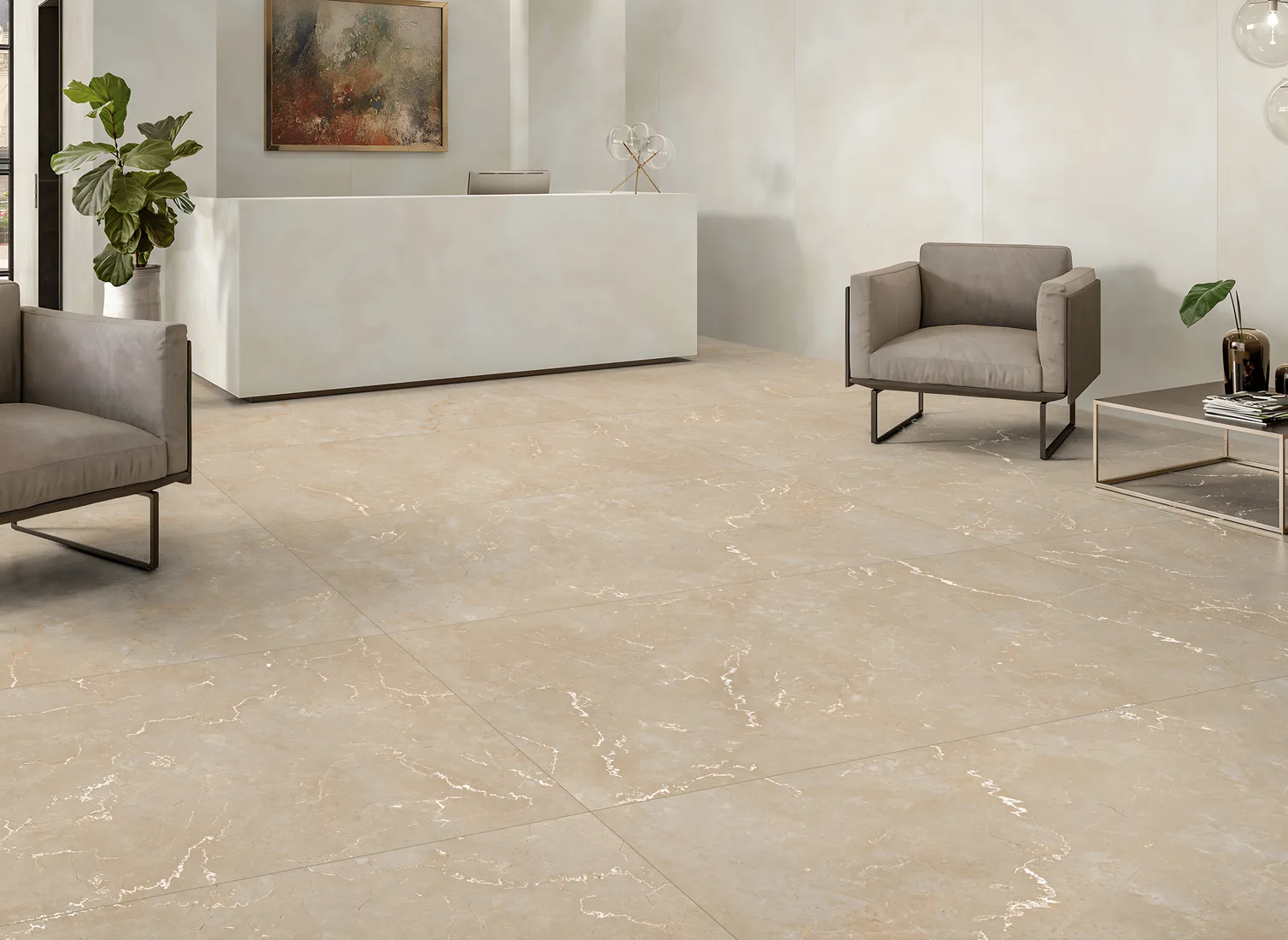
A one-metre square is a clean, round number that architects like. At 100 × 100 cm (1000 × 1000 mm), a tile covers one square metre exactly, which makes quantity takeoff simple and gives a floor with a very quiet rhythm. It sits between the common 80 × 80 cm and the monumental 120 × 120 cm squares.
The specification
At Lumina Tile, 100 × 100 cm is in the Porcelain Floor Tiles category, in 8, 9, 10 and 12 mm thickness. Surfaces are Glossy, Matt and Carving. The wider range of Sugar, Lapato, R-rated and Rustic finishes is limited to smaller sizes, so if you need a slip-rated surface for a wet area, consider 80 × 80 cm instead.
What a metre square does well
- Simple maths. One tile is one square metre. A 40 square metre floor needs 40 tiles plus allowance, which makes ordering and budgeting clear.
- Few joints. Joint length per square metre is low. A floor looks nearly continuous.
- Proportion in big rooms. In rooms above about 25 square metres, the size looks deliberate rather than oversized.
It is less successful in small rooms, where cuts at the edges dominate the look, and in narrow corridors where only one tile fits across.
Choosing the size and thickness
Compared with the neighbouring squares
| Size | Area per tile | Surfaces at Lumina Tile | Best room size |
|---|---|---|---|
| 80 × 80 cm | 0.64 sq m | Nine surfaces | Medium to large |
| 100 × 100 cm | 1.00 sq m | Glossy, Matt, Carving | Large |
| 120 × 120 cm | 1.44 sq m | Glossy, Matt, Carving | Very large |
If you are torn between squares, think about the typical room dimension. A tile should fit a room an exact number of times where possible, or leave cuts of at least a third of a tile at the edges.
Thickness choice
A 100 × 100 cm tile at 8 mm is relatively flexible and needs a very flat, fully supported bed. For most floors, 9 or 10 mm is the sensible starting point. Choose 12 mm for commercial traffic, trolleys and heavy furniture. Check how thickness affects pack weight in the packaging details.
Installing and handling
Installation: what matters most
- Flatness. Check with a long straightedge. Fix high spots and fill low ones before laying.
- Adhesive. Use a large-format adhesive and comb both surfaces for full coverage. A tile this size with voids will crack.
- Levelling. Use clips and wedges to hold neighbouring tiles at the same height while the adhesive cures.
- Lifting. Use suction handles and two people. Avoid carrying on the flat.
- Movement joints. Provide them at walls and at doorways, and at regular intervals on a large floor.
Underfloor heating works well with porcelain, but the heating needs to be commissioned and brought up gradually before and after tiling, and the movement joints need to be planned for the heated zones.
Delivery and handling
Check the route into the building. A metre-square tile is easy to carry through a standard door, but a crate of them is heavy. Plan for a pallet truck or a forklift on site, and store crates on a firm, level surface until needed. Order a modest overage, and keep a few spare tiles from the same batch for future repairs. The tiles calculator gives a baseline.
Design pairings
A metre square works well with a restrained palette. Pair it with timber or plaster walls, slim skirting and minimal furniture, and the floor does the visual work. In a hotel lobby or a showroom, a veined marble design in Glossy gives a high-end look, while a stone or concrete look in Matt suits offices and homes. If the pattern has strong veining, rotate alternate tiles only if the design supports it, otherwise lay them in one direction to keep the veins flowing.
Because one tile is one square metre, it is easy to explain a layout to a client: count the tiles across and along. This simplicity helps with sign-off on drawings.
What to confirm with your installer
- Whether they have laid tiles of this size before, and what equipment they use.
- The adhesive and levelling system they will use.
- How they will protect the finished floor on a busy site.
- The plan for cuts at doorways and around fixtures.
Common questions
Is 100 × 100 cm a standard size?
It is less common than 60 × 60 or 80 × 80 cm, which is part of its appeal for designers who want something distinctive but not extreme.
Can I use it on walls?
Yes, in a thinner option, provided the wall is flat and the fixing is designed for the weight.
Where can I see designs?
The porcelain floor range lists designs by size.
If a metre square suits your project, give Lumina Tile your room list and port through the contact page and we will advise on thickness and packing.