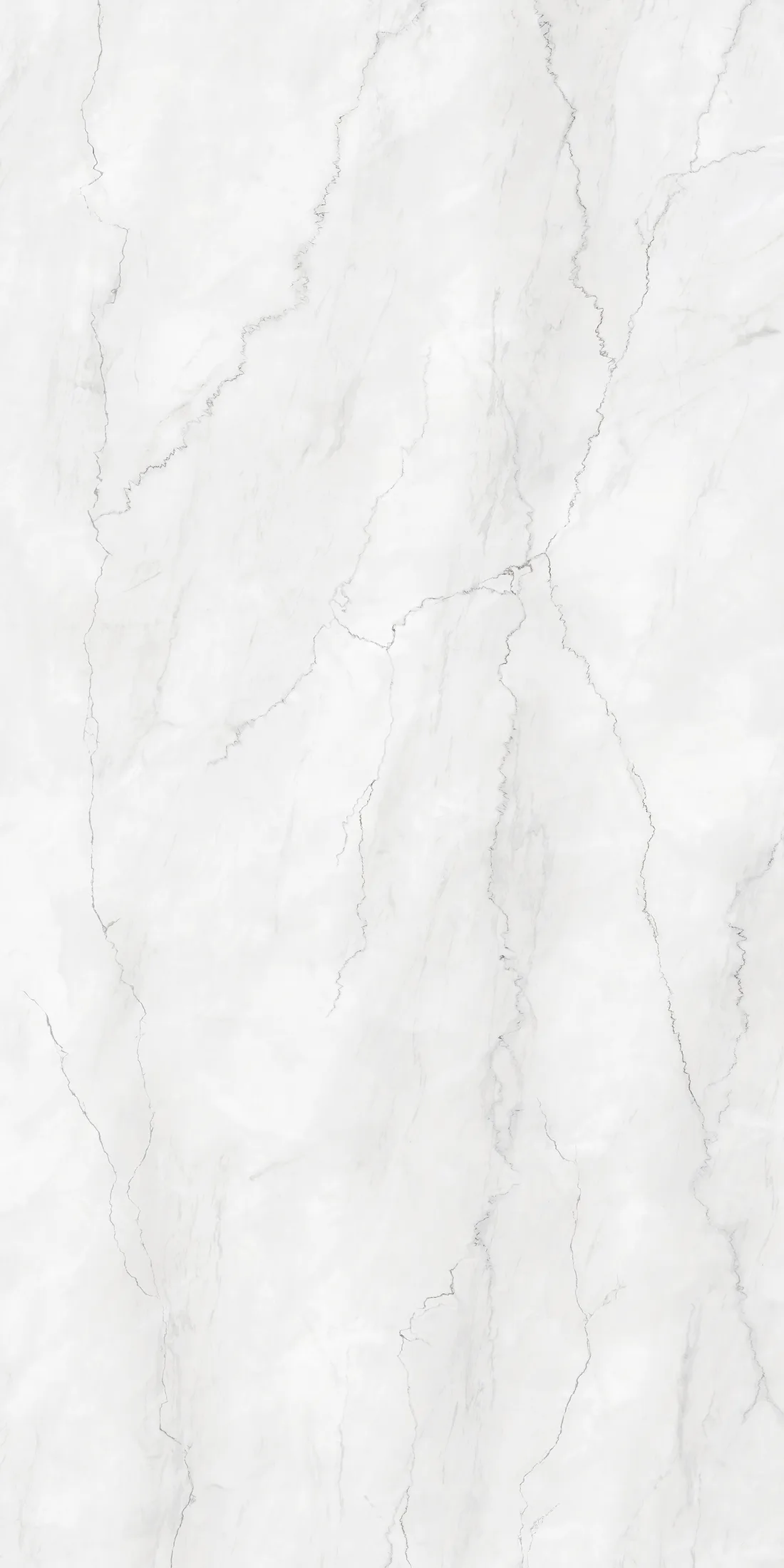
At 120 × 180 cm (1200 × 1800 mm), a tile stops behaving like a tile and starts behaving like a surface. A single piece covers more than two square metres. Used well, that gives you rooms with almost no visible joints. Used carelessly, it gives you cracked corners and expensive cuts.
This guide is about design: where to use the size and what it does visually. The size is part of the Porcelain Floor Tiles range at Lumina Tile, in 8, 9, 10 and 12 mm thickness, with Glossy, Matt and Carving surfaces.
Five design ideas
Idea 1: A continuous floor across an open plan
The strongest use is a floor that runs without interruption from kitchen to living area. With a rectified edge and a joint close to the tile colour, the floor reads as one plane. Choose a design with movement but not strong repeating pattern, such as a cloud-like marble or a soft concrete effect, so the eye is not drawn to repeats.
Lay all tiles in the same direction. At this size, rotating tiles to break repeats is usually unnecessary, because the repeat distance is already large.
Idea 2: Floor-to-wall continuity
Running the same slab up a wall behind a kitchen island or a bed creates a feature without introducing a second material. Matching the floor and wall pattern gives a cohesive, architectural look. Because 120 × 180 cm is much taller than a standard 2.4 m wall requires in a single drop, you will cut tiles. Plan where the cuts fall so veining continues sensibly.
Idea 3: Bookmatched feature walls
Where designs allow, two adjacent tiles can be mirrored to form a bookmatch. This works best with a strongly veined design. Ask the supplier whether a design and its numbered sequence support matching, and confirm before purchase. Not every design is made to be matched.
Idea 4: Worktops and vanity surfaces
Large porcelain pieces can be cut to form kitchen worktops, island tops and vanity tops. For these, a thicker option offers a more robust edge profile. Specialist fabricators handle the cutting, because internal corners need generous radii to avoid cracking.
Choosing the surface
| Surface | Look | Best used for |
|---|---|---|
| Glossy | Reflective, bright | Walls, dry feature floors |
| Matt | Soft, practical | Most floors, kitchens |
| Carving | Textured, relief | Feature walls, added grip |
A glossy floor looks spectacular on the day it is installed and shows every footprint after that. For a family home, matt is the safer pick.
What to plan before falling in love with the look
- Access. Check door widths, stair turns and lift sizes. A 1.8 m edge needs a clear route.
- Substrate. The floor must be extremely flat. Grind high spots and screed low ones before laying.
- Installers. Use a team experienced with large format, with a proper vacuum lifter and levelling system.
- Cut waste. A room that is not a multiple of the tile dimensions leaves offcuts. Plan the layout so cuts are useful, and allow more overage than you would for small tiles.
- Delivery. Large tiles ship in crates. Review the packing details to see how this format is boxed.
When another size is a better answer
If the room is narrow, or full of cut-outs such as columns and alcoves, a 120 × 120 cm or 80 × 160 cm tile will waste less. If you want a taller, wall-only slab, the large slab range goes up to 160 × 320 cm. Large surfaces are about the right match between room and tile, not about choosing the biggest number.
Idea 5: Zoning with a change of direction
In an open plan, you can mark the dining area, the lounge and the hall by rotating the tile direction between zones, while keeping the same design. The material stays continuous, but the change of orientation quietly defines each space. At 120 × 180 cm, each zone needs a clean joint line, so place the change at a doorway or a rug edge.
Colour and pattern choices
Large tiles amplify what is printed on them. A busy, high-contrast pattern is overwhelming across several square metres, while a soft, tonal design lets the size do the work. Light tones make rooms feel open. Dark tones feel dramatic but show dust and scratches, so they suit rooms with careful maintenance. Browse the full design library to compare patterns before choosing.
Common questions
Is 120 × 180 cm a slab or a tile?
The market uses both words. Lumina Tile lists it with the porcelain floor tiles, with the 6 to 20 mm slab category reserved for larger formats.
Will it crack easily?
Not if the substrate is flat, the bed has full coverage and the movement joints are in place. Most failures come from voids and uneven bases.
Can I order only a few pieces for a feature wall?
Orders are shipped by the container, but mixed sizes and designs are permitted within one load. Discuss quantities on the contact page.
Have a design in mind? Share the room plan with Lumina Tile and we will advise whether 120 × 180 cm is the right format, and how to pack it for your port.