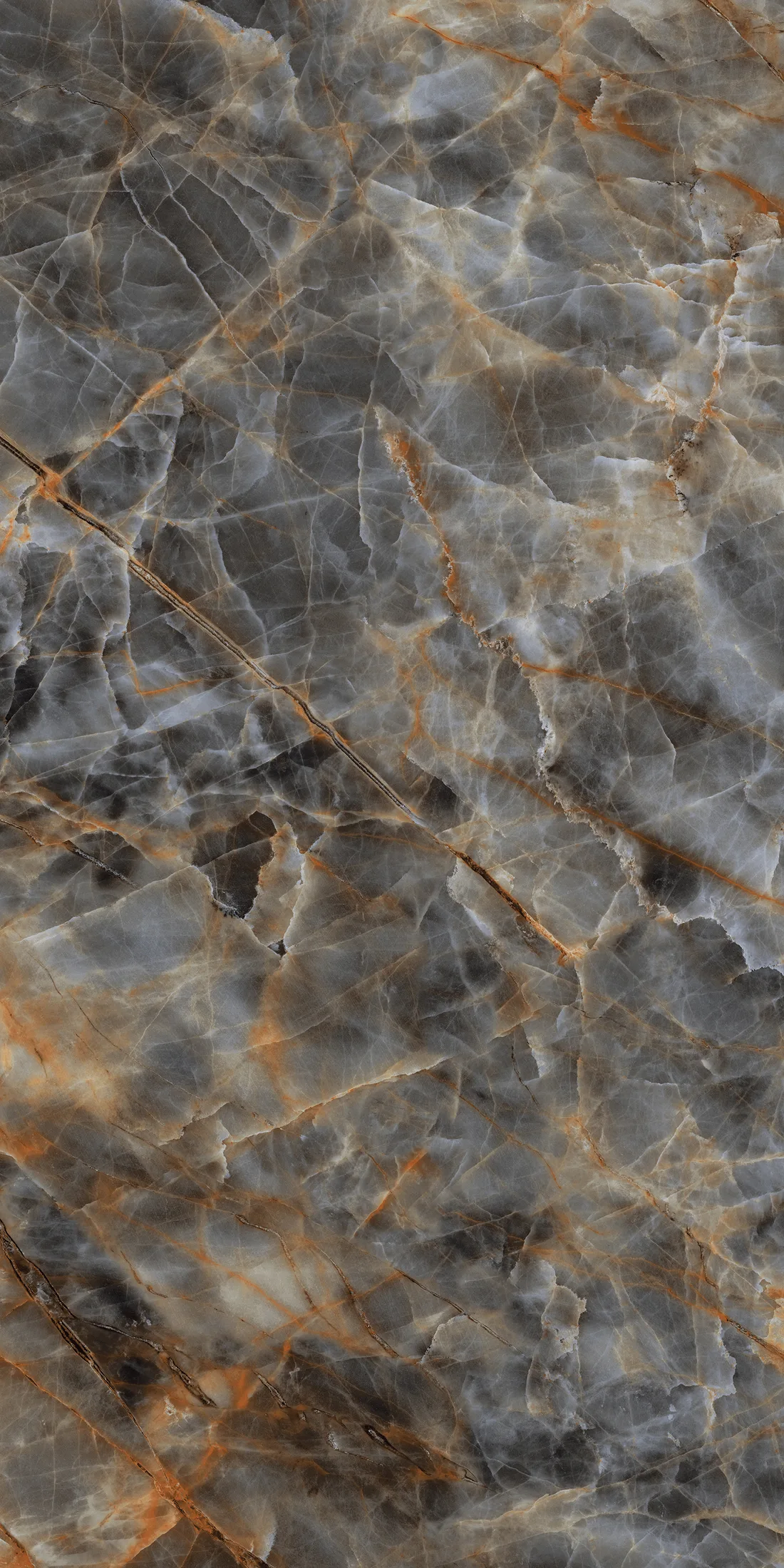
Soluble salt tiles are the polished, marble-look tiles that fill many showrooms. They are popular for a reason: the colour looks deep, the veining looks soft and the surface shines. They also have limits that sales literature skips. This guide gives both sides, so you can decide whether they suit your market and your customers.
How they are made
Soluble salts are water-based inks made from metal salts. They are applied to the surface of an unglazed tile body, usually by printing. During drying and firing, the inks soak into the surface, instead of sitting on top like a glaze. The tile is then polished, which cuts back the top layer and reveals the colour that has sunk in.
The result is a surface with a soft, diffuse pattern that has some depth, rather than a sharply printed image. This is why soluble salt marbles look natural and cloudy.
What Lumina Tile offers
The Soluble Salt and Double Charge category is supplied in 60 × 60 cm (600 × 600 mm), in a Glossy surface, 8 to 9 mm thick. It is a single-size, single-surface product line. If you need other sizes or surfaces, look at the porcelain floor range.
Strengths and weaknesses
Strengths
- Depth. The pattern sits in the surface, which gives a more natural, three-dimensional look than a flat print.
- Gloss. Polishing gives a high-shine finish that brightens rooms.
- Value. The look of polished marble is available in a manufactured tile, which broadens its market.
- Easy to match. Standard 60 × 60 cm size with plenty of designs makes it easy to stock.
Weaknesses buyers should know
- Porosity. Polishing opens microscopic pores at the surface. Compared with glazed porcelain, a polished unglazed face absorbs stains from oil, wine and coloured liquids more readily. Many installers seal the surface.
- Scratches. A polished face shows fine scratches and wear patterns in traffic routes, especially under grit.
- Slip risk. A high-gloss polished face is slippery when wet. It is not suited to entrances, wet rooms or outdoor use.
- Limited pattern detail. The pattern is soft by nature. Sharp, detailed images are done better with glazed digital printing.
Comparison
| Feature | Soluble salt | Glazed porcelain | Full body |
|---|---|---|---|
| Pattern depth | Soft, sunk into surface | Printed on glaze | Through the body |
| Stain resistance | Lower unless sealed | High | High when unpolished, lower when polished |
| Slip when wet | High risk | Depends on surface | Depends on surface |
| Best for | Dry living and display areas | Almost anywhere | Heavy traffic |
Reading the quality of a soluble salt tile
Because the look comes from the polish and the ink, quality varies more than with a simple plain tile. When you assess a design, look at four things.
- Gloss uniformity. Tilt the tile under a light. The shine should be even, without cloudy patches or swirl marks.
- Pattern continuity. The veining should look natural and not repeat visibly across a layout of several tiles.
- Edge and corner quality. Chips at the corners point to rough handling or weak body.
- Flatness. Lay two tiles face to face or place a straightedge across the surface. Warp is very visible on gloss.
Inspect tiles from several cartons, not just the top of one pallet. A buyer who checks the first box and ships the container is trusting luck.
Where they fit well
Living rooms, bedrooms, offices, showrooms, hotel lobbies in controlled conditions and any dry interior where the look is the priority. Avoid kitchens with heavy cooking, bathrooms, entrances and any exterior space.
Buying and installing
- Check shade across cartons before fixing, because pattern and tone can vary.
- Ask for the technical file on water absorption and surface values via the technical details page.
- Use light-coloured, non-staining grout and wipe adhesive off the polished face immediately.
- Protect the surface during construction with board or paper, and clean before handover.
- Consider a sealer designed for polished porcelain, and test on a spare tile first.
Common questions
Is soluble salt the same as double charge?
No. Double charge uses a thick pressed surface layer instead of ink. Both are listed together in one category and often look alike, so ask which method a design uses.
Can I use it in a kitchen?
You can, with sealing and care, but a matt glazed porcelain tile is a safer choice.
Will it fade?
The colour is fired into the body, so it does not fade in normal indoor light, though the shine can dull with wear.
If a polished 60 × 60 cm tile suits your market, Lumina Tile can quote it on the contact page, with all documents for your port.