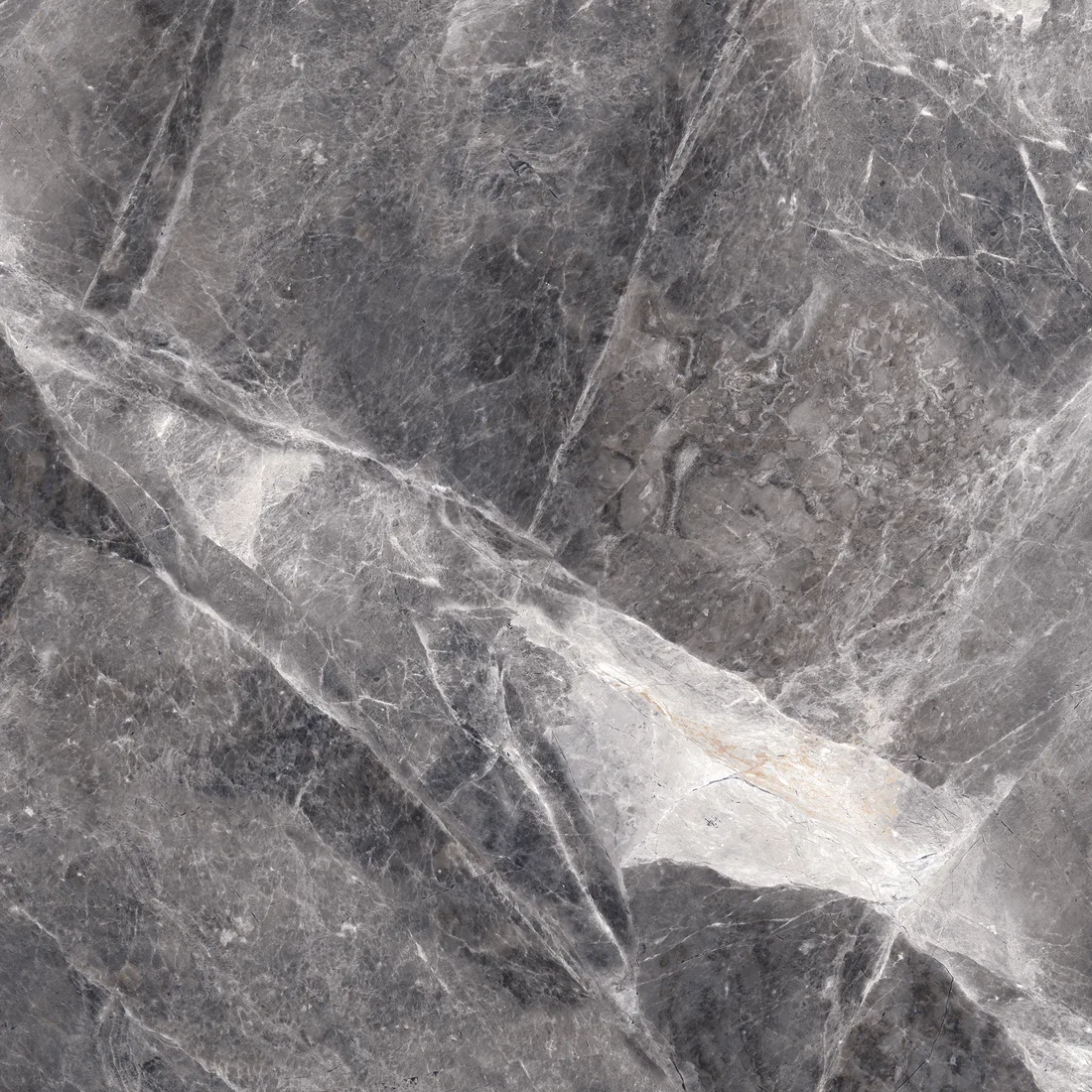
A good marble look tile is judged on three things: how convincing the veining is, how the surface catches light, and how the tiles behave when laid side by side. Most disappointments come from the third. A beautiful single tile can look repetitive and flat once forty of them cover a floor.
Why buyers choose marble look over marble
Natural marble is porous, reacts with acids and varies from block to block. Porcelain marble look tile keeps the appearance and removes most of the maintenance. Water absorption in porcelain is at or below 0.5 percent, so it resists staining, and it handles lemon juice, wine and cleaning products that would etch real marble. It also arrives in consistent grades and sizes, which helps when a project is phased over several shipments.
Understand the vein styles
- Carrara style: soft grey veins on a white or pale grey ground. Quiet and the easiest to match to other finishes.
- Calacatta style: bold, irregular veins, often with gold or brown tones, on a bright white ground. High impact, best on large surfaces.
- Statuario style: strong, clearly defined grey veins with open white areas. Elegant in lobbies and living rooms.
- Emperador and brown marble: dark brown ground with cream veining. Warm and traditional.
- Black and green marble: deep grounds with gold or white veins. Used in feature walls and hospitality.
Veining is mostly decorative randomness, so the real question is variety. Ask how many different faces a design has and whether the veins are printed to flow across tile edges.
Surface finish changes the look
Marble is traditionally polished, so many buyers default to glossy. That is sensible for walls and low traffic areas. For floors, consider the alternatives.
| Surface | Look | Best use |
|---|---|---|
| Glossy | Mirror shine, deep veins | Walls, lobbies, feature floors |
| Matt | Soft, natural stone | Homes, kitchens, bathrooms |
| Carving | Surface texture following the vein | Walls and design led floors |
| Lapato | Part polished, part matt | Retail and corridors |
Lumina Tile supplies marble look designs in glossy, matt and carving across large porcelain formats, with lapato available in selected sizes. Check the catalogue for which surface is offered in which size.
Pick the size for the effect you want
Marble is naturally cut in big slabs, so large formats look more authentic. A 60 × 120 cm (600 × 1200 mm) tile is a good baseline. For a seamless look in a living space, 80 × 160 cm or 120 × 120 cm reduces joints. In the large slab range, sizes go up to 160 × 320 cm, which allows entire walls and counters with almost no visible joints.
Smaller tiles such as 60 × 60 cm still work in bathrooms and corridors, and 30 × 60 cm ceramic wall tiles give a marble look wall at a lighter weight.
Planning the layout
- Use a narrow joint. Rectified tiles allow tight joints that read as continuous stone. Wide grout lines break the illusion.
- Match grout to the ground colour, not the vein.
- Mix tiles from the box. Shuffle faces before laying so similar veins do not sit together.
- Consider book matching. Some large format designs are supplied in mirrored pairs. Confirm availability at quote stage, as it affects quantities.
- Keep the pattern consistent. Lay all tiles in the same direction unless the design is specifically made to rotate.
Mistakes that make marble look fake
Three things give it away. Wide, contrasting grout lines. A single face repeated across the floor. And a glossy finish in a space where real marble would be honed, such as a kitchen or an outdoor-facing hall. Fix those three and most porcelain marble passes for stone at normal viewing distance. Also check that edges are rectified, because chipped or bevelled edges reveal a printed tile.
Think about wall and floor together. A veined floor with a veined wall competes. Pair a strongly veined surface with a quieter partner, such as a plain pale matt tile, and the stone gets room to perform.
Common questions
Can marble look tile be used on floors?
Yes. Choose a matt or lapato surface for a floor that will see water, and check the slip resistance requirement for the space. Glossy floors suit dry, low traffic interiors.
Will it look repetitive?
Not if the design has multiple faces and you mix boxes while laying. Ask about the number of faces before you commit to a design for a large floor.
Is it cheaper to maintain than marble?
Generally yes. There is no sealing cycle and no etching from acidic cleaners. A neutral cleaner and a clean mop are enough.
To compare marble look designs in your target sizes, browse all designs or send the sizes and quantities you need through the contact page.