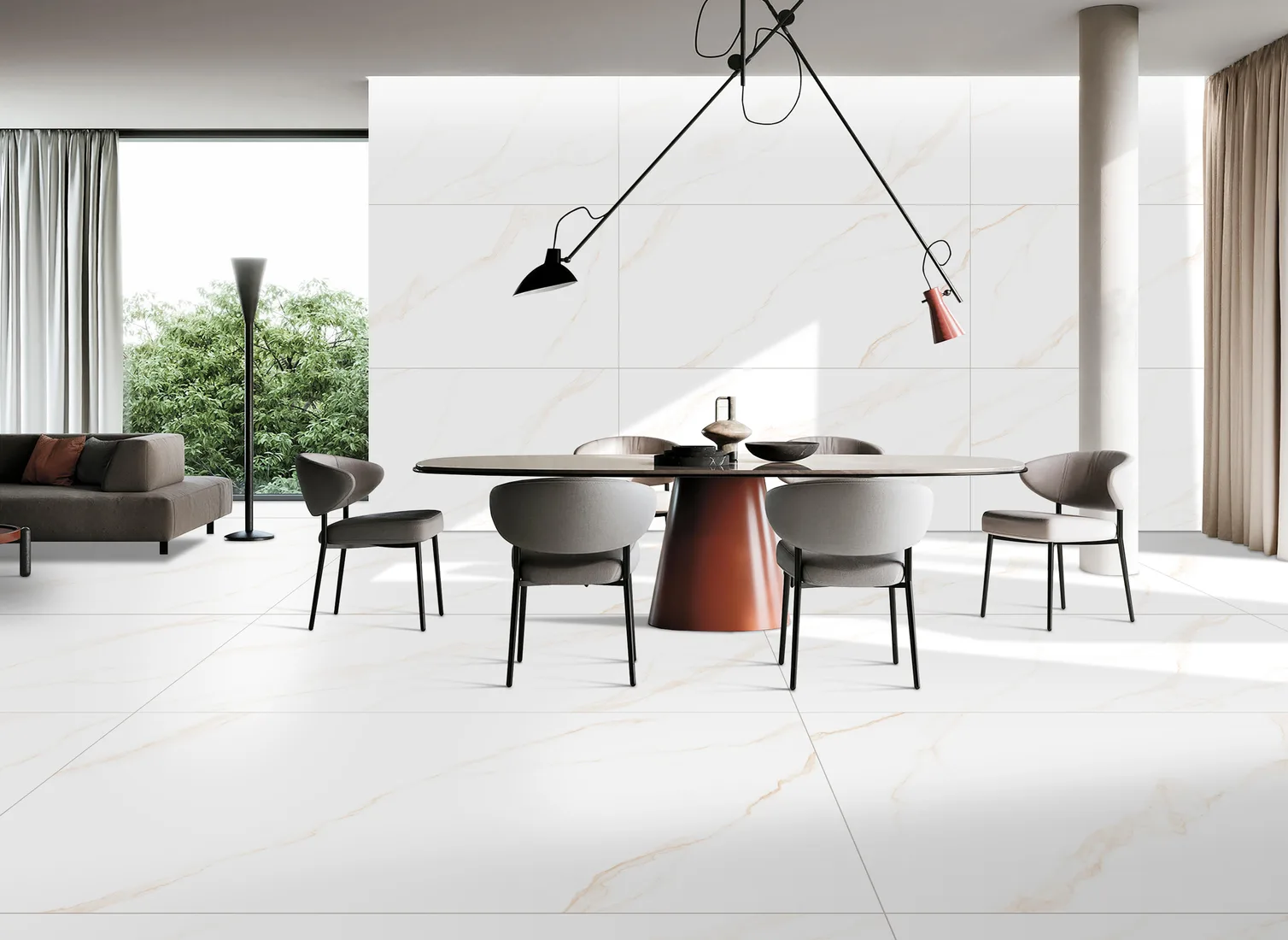
Natural marble is a limestone that has recrystallised under heat and pressure. It is beautiful, one of a kind and soft. Marble-look porcelain is a fired tile with a printed surface that imitates it. The honest comparison is not about which is "real", but about how each behaves in daily use.
Behaviour of natural marble
Marble is made mainly of calcite, which reacts with acids. Lemon juice, wine, vinegar and many household cleaners can etch the surface, leaving dull marks. It is porous, so oils and dyes can stain it unless sealed, and sealers need renewing. It is also softer than porcelain and scratches more easily. Over years it develops a patina, which some owners love and others dislike.
Each slab is unique, and colour can vary significantly between blocks and batches.
Behaviour of marble-look porcelain
Porcelain is dense, with very low water absorption, at or below 0.5 percent. It resists stains, acids and scratches far better than stone. It does not need sealing. The printed pattern is consistent, so a matching batch is easy to reorder. Modern printing is detailed enough to reproduce veins, crystals and tonal depth that are hard to tell from stone at normal viewing distance.
Comparison table
| Factor | Natural marble | Marble-look porcelain |
|---|---|---|
| Staining | Porous, needs sealing | Highly resistant |
| Etching by acids | Yes | No |
| Scratching | Scratches easily | Much harder |
| Consistency | Varies block to block | Consistent, repeatable |
| Uniqueness | Every slab is unique | Pattern repeats across faces |
| Weight | Heavy at standard thickness | Lighter in thin large formats |
| Upkeep | Sealing, polishing, careful cleaning | Simple cleaning |
| Outdoor use | Limited, depends on stone and climate | Possible with outdoor-rated tiles |
| Supply | Quarry dependent | Manufactured to schedule |
Where porcelain makes more sense
Kitchens, bathrooms, restaurants, hotels, shops and rental properties benefit from porcelain's resilience. Large slabs can clad a whole wall or make a vanity or countertop with a marble look and no sealing routine. For a developer who needs 200 identical apartments, the consistency of a manufactured product is a real advantage.
Lumina Tile's large slab tiles can reach 160 × 320 cm in thicknesses from 6 to 20 mm, in Glossy, Matt and Carving, which allows marble-look surfaces with very few joints.
Where natural marble still wins
Natural marble has a depth and translucency that no print fully copies, especially in very light stones. It can be honed and repolished on site, which gives it a long, renewable life. For a signature lobby, a high-end residence or a heritage restoration, stone remains the benchmark. Clients who want genuine material for its own sake will never be satisfied with a copy.
Choosing a good marble-look tile
- Check the number of faces. More faces give a more natural repeat.
- Look at edges. Rectified tiles with narrow joints read as continuous stone.
- Choose gloss or satin for the strongest stone effect, matt for modern calm.
- Compare the printed vein scale to the tile size. Veins should feel proportional.
- Match the grout to the background, not the vein.
Browse all designs to see the range of marble looks and check the catalogues for sizes and surfaces.
Weight and structure are often overlooked. Natural marble slabs at normal thickness add serious load to a floor or wall, and may need reinforced fixing. Thin porcelain slabs weigh much less per square metre, which helps on upper floors, in refurbishments and in lifts and stairwells where large pieces must be carried.
Sustainability and supply also differ. Stone is quarried and its availability depends on the block. A manufactured tile can be reordered from the same design family, which makes phased projects and later repairs easier to manage.
A sensible compromise for a premium project is to use natural stone for a single hero element, such as a reception desk or a lobby feature, and marble-look porcelain for the surrounding floors and walls. The eye reads the whole space as stone, while the budget and the upkeep stay under control.
Whichever you choose, ask for the full technical data on the product you are given. Lumina Tile can share specification details so that your architect or consultant can compare the porcelain against the stone alternative on equal terms.
Common questions
Will guests notice it is not real marble?
In large formats with varied faces, rarely. Close inspection of a repeating vein may show it.
Is porcelain cheaper than marble?
Often, both for material and upkeep, but costs vary by design and market, so request a quotation to compare.
Can porcelain be used on kitchen counters?
Yes, in slab format with a suitable thickness and fabrication.
Share your design reference and area through the contact page and we will find marble-look porcelain that matches the brief.