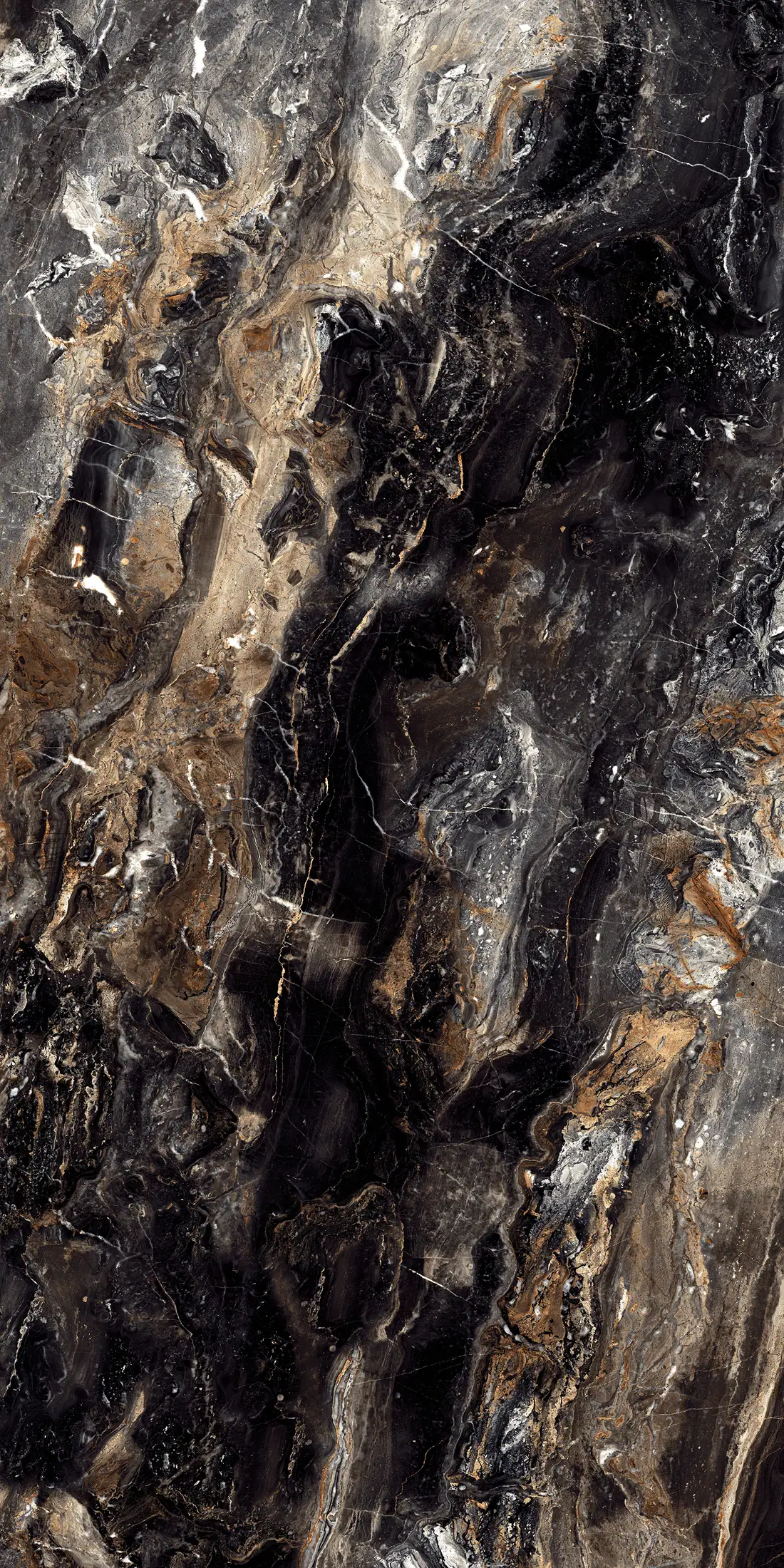
Chip a glazed tile and you often see two layers: a thin decorated surface and a different-coloured body below. Chip a full body tile and you see the same colour all the way through. That single difference explains almost everything about where full body tiles are used and why buyers choose them.
What full body means
In a full body porcelain tile, the colour and pattern are mixed into the body powder before pressing, so they run through the whole thickness. There is no separate glaze layer to wear through. Chips, scratches and edge wear show the same colour as the face, so they blend in.
The tile is also dense. Porcelain bodies absorb very little water, at or below 0.5 per cent, and are hard. Together these give a tile that suits tough conditions.
What Lumina Tile offers
The Full Body Floor Tiles category is supplied in 8, 9 and 10 mm thickness, in three sizes:
- 30 × 30 cm: Matt
- 60 × 60 cm: Glossy and Matt
- 60 × 120 cm: Glossy and Matt
This is a focused range. For other sizes or textured surfaces, look at the glazed porcelain floor range.
Full body versus glazed porcelain
| Question | Full body | Glazed porcelain |
|---|---|---|
| Colour depth | Same throughout | Surface layer over a different body |
| Chips and edges | Hard to see | Can show a contrasting body colour |
| Wear in heavy traffic | Wears evenly | Glaze may thin along main routes |
| Design variety | More limited, typically simpler patterns | Very wide, including detailed prints |
| Typical look | Stone, concrete, plain colours, speckled | Marble, wood, patterns, anything |
Because the pattern is made by mixing powders, full body designs tend toward stone, terrazzo-like, concrete and plain looks. Highly detailed images, such as a realistic wood grain, are the glazed tile's domain.
Where and which size
Where full body earns its place
- Commercial interiors: shops, supermarkets, offices and airports where foot and trolley traffic wear a path.
- Educational and healthcare buildings: long life and easy cleaning matter more than ornament.
- Public circulation areas: corridors and stations.
- Homes with a minimalist taste: a plain, speckled or concrete look in a hard-wearing form.
It does not offer much for a bedroom with light traffic, where a glazed tile will wear for decades anyway.
Choosing among the three sizes
Each of the three sizes has a clear role.
- 30 × 30 cm Matt suits small areas, stair landings, utility rooms and detail work. It is also useful when the tile must be carried through tight access.
- 60 × 60 cm is the general-purpose option for offices, shops and homes. With Glossy and Matt, it covers both showroom and everyday floors.
- 60 × 120 cm gives a larger, more architectural look for lobbies, open-plan offices and retail halls, with fewer joints to clean.
For a commercial buyer, the cleaning story matters as much as the look. Fewer joints in a 60 × 120 cm layout means less grout to maintain, and a uniform body hides the small marks that a busy floor collects.
Installation and ownership
Cutting and installation notes
Dense, full body tiles are hard on blades. Use a good diamond blade and a wet saw, and allow more time for cutting than with ceramic. Edges that will be exposed, such as at steps or at a threshold, can be finished by grinding or with a trim, and they look good because the colour is the same all the way through. This is a real advantage over glazed tiles, whose cut edge shows the body colour.
Use a suitable adhesive for dense porcelain, since low-absorption bodies need an adhesive that bonds mechanically and chemically to a tight surface. Back-butter larger tiles.
Cost of ownership
A full body floor is often chosen not for its first appearance but for what it looks like in ten years. A floor that wears evenly needs less repair and keeps its look across heavy traffic routes. When you compare options, weigh the life of the floor against the initial specification, and speak to your contractor about maintenance cycles, not just the installation day.
Specifying it
Surface choice
Matt is the practical default. It gives grip and hides marks. A polished full body tile can be striking in a lobby, but it is slippery when wet and shows scratches. Match the surface to the exposure, and ask for slip data on the technical details page.
What to check before ordering
- Shade consistency. Check tiles from different cartons together before fixing. Full body tiles can vary between batches.
- Calibre. Rectified tiles allow tight joints.
- Thickness. Choose 10 mm for heavy commercial floors.
- Grout colour. Match it to the body for a seamless floor.
- Packing and weight. Check the packaging details before planning containers.
Common questions
Is full body the same as through-body?
The terms are used interchangeably in the trade. Always confirm with the supplier that colour runs through the full thickness.
Is full body harder than glazed porcelain?
Both are dense porcelain. The advantage is that surface wear does not reveal a different layer, not that the material is harder.
Can it go outdoors?
For exterior areas, use a rated outdoor product. See the outdoor porcelain range.
If you are specifying a commercial floor, send Lumina Tile your size, traffic level and destination through the contact page.