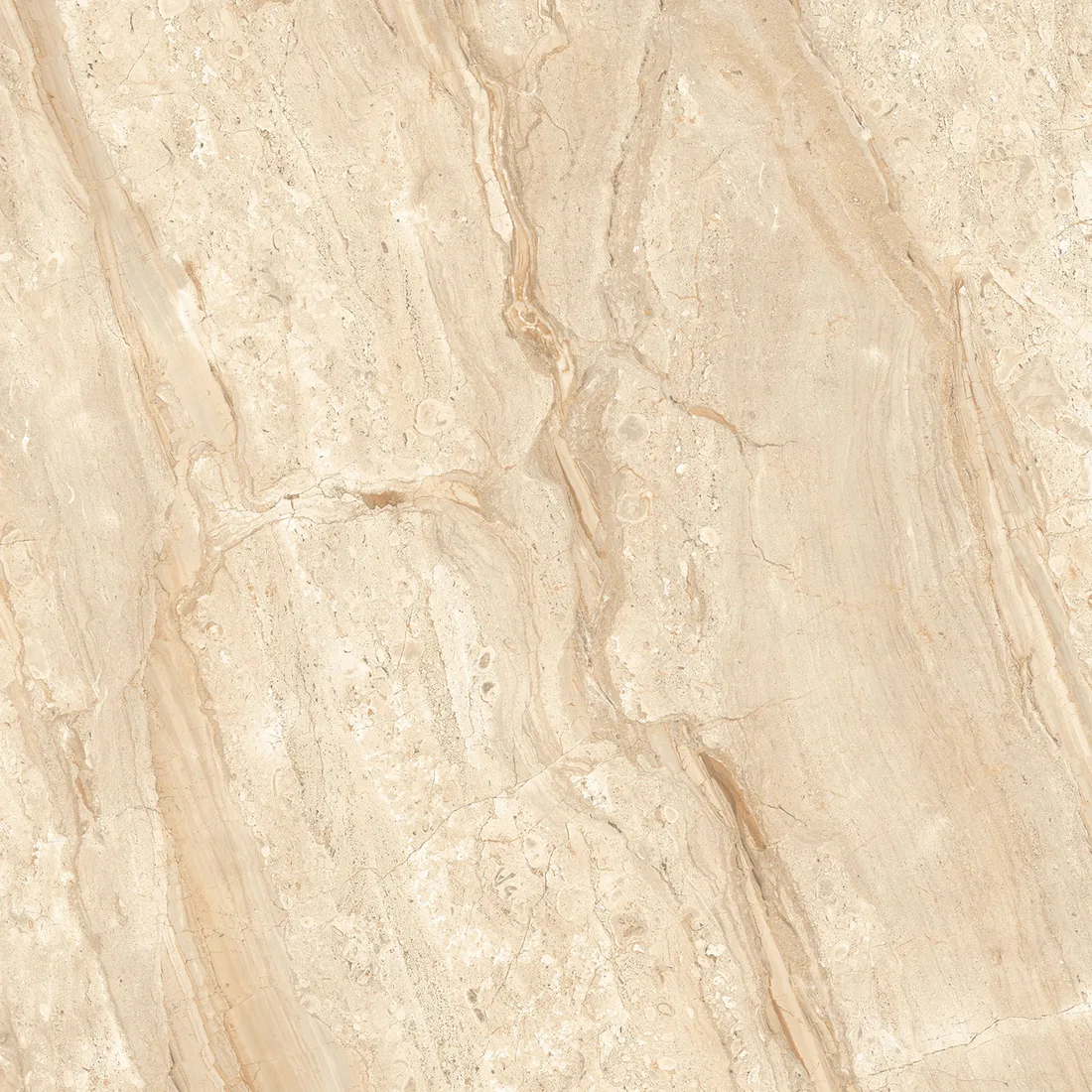
A double charge tile is pressed in two stages. The tile press is filled with a first layer of powder, and then a second layer, usually the decorative one, is added on top before pressing and firing. The result is a tile with a distinct pigmented surface layer over a base body. It is a way of getting colour and pattern depth without colouring the whole tile.
How the process works
- Body powder is loaded into the die as the base.
- Surface powder, often a coloured or patterned mix, is loaded on top, forming a layer a few millimetres thick.
- Pressing compacts both layers into one tile.
- Firing bonds the layers into a single body.
- Polishing, for a polished tile, removes the top surface to give a smooth, glossy face.
The surface layer is much thicker than a glaze, and it is part of the tile, not a coating. Because of that, polishing exposes more of the same colour instead of wearing through to a different body.
What Lumina Tile offers
Double charge is supplied together with soluble salt tiles in one category, Soluble Salt and Double Charge. The size is 60 × 60 cm (600 × 600 mm), in a Glossy surface, with a thickness of 8 to 9 mm. It is a focused product line for buyers who want a polished, decorative floor in the most universal format.
Double charge compared with other bodies
| Property | Glazed porcelain | Double charge | Full body |
|---|---|---|---|
| Decoration | Printed glaze on surface | Pigmented surface layer, a few mm thick | Same colour through the whole tile |
| Surface wear | Glaze can wear on heavy traffic | Better than a glaze, as the layer is thicker | Best, as there is no layer to wear through |
| Polished look | Glossy glaze | Polished body | Polished body |
| Typical use | Wide | Showrooms, homes, offices | Commercial, heavy traffic |
A full body tile is the same colour throughout. A double charge tile is a step down from that in depth but a step up from a glaze. See our guide on full body floor tiles if you need the through-colour option.
Where to use double charge tiles
- Living rooms and bedrooms, where you want a polished marble-like floor.
- Offices and reception areas, where foot traffic is moderate and the look matters.
- Retail and showrooms, where gloss reflects light and brightens the space.
- Feature floors and walls, within dry interior areas.
Polished tiles are not the best choice for wet areas, entrances or ramps, because a polished surface is slippery when wet. For those, choose an R-rated porcelain tile from the porcelain floor range.
Buying checks
- Look at the edge. A well-made double charge tile shows a clear, even surface layer on the edge, not a ragged one.
- Check the shade across cartons. The decorative layer varies by batch, so order all of one design together.
- Check flatness and calibre. Polished tiles show lippage and uneven joints immediately.
- Ask about the surface finish. Request the technical details for water absorption and slip values. See the technical details page.
- Plan protection on site. Polished surfaces scratch if grit is dragged on them during construction. Cover them until handover.
Wear and care
Why the thickness of the layer matters
A glaze is a thin film, measured in fractions of a millimetre. A double charge surface layer is many times thicker. In practice, that means a polished double charge tile can be ground and polished without cutting through the decoration, which is important because polishing removes material. It also means that small chips on the surface show the same colour underneath, rather than a different body colour, though the base layer below the decorated one can differ in tone.
This is the reason the product exists. It gives a more durable, more natural-looking decorated floor than a thin printed finish, while using less coloured powder than a full body tile.
Care
Clean with a neutral detergent and a soft mop. Avoid acidic or abrasive products. Use mats at entrances to capture grit. If the surface has dulled in a high-traffic route, a professional can restore the shine.
Common questions
Is double charge the same as soluble salt?
No. They are different decoration methods, although they are often polished and sold in the same look. Soluble salt tiles are decorated by salt-based inks that sink into the surface. Because both are polished and sold together, buyers often confuse them, so ask which method a design uses.
Is it as durable as full body?
For normal use, it is durable. In very heavy traffic, full body gives more margin.
Can it be used on underfloor heating?
Yes. Porcelain-type bodies conduct heat well, and movement joints should be planned.
For a polished 60 × 60 cm floor, send your quantity and port to Lumina Tile via the contact page.