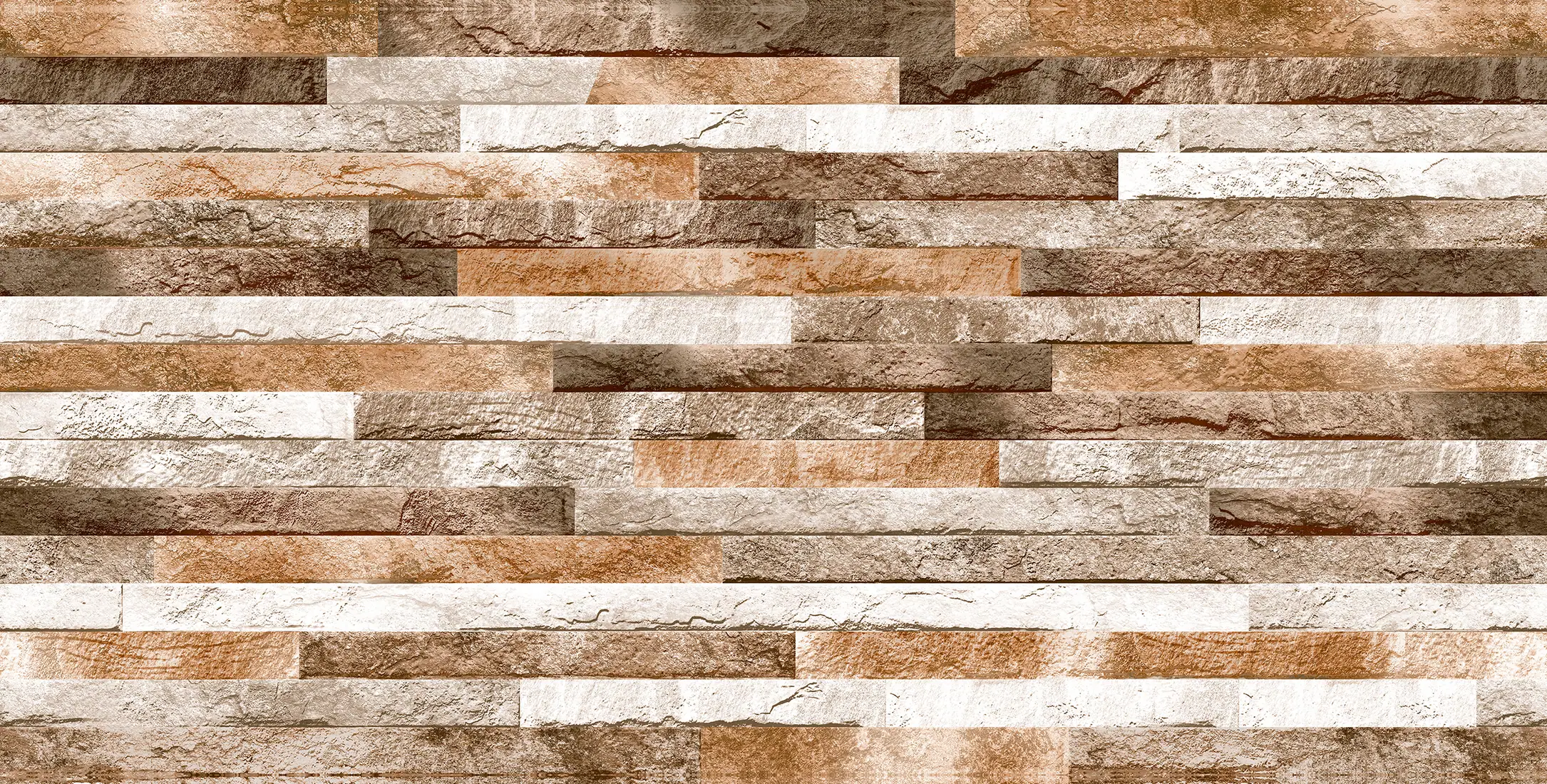
For most interior walls, ceramic is the sensible default and porcelain is the upgrade. That is a simplification, but it is a useful starting point. Walls do not take the abuse that floors do, so a lighter, easier-to-cut ceramic tile often does the job at lower cost. Porcelain earns its place when moisture, size or hardness becomes a concern.
Differences in the body
Ceramic tiles are made from red or white clay, pressed and fired at a lower temperature. They have a porous body with higher water absorption, and rely on a glaze to make the surface waterproof. Porcelain is made from finer clays and fired at higher temperatures, giving a denser body with water absorption at or below 0.5 percent.
On a wall, the glaze does most of the visible work either way. The body shows only at the edges and the back.
Comparison table
| Factor | Ceramic wall tile | Porcelain wall tile |
|---|---|---|
| Body | Clay, more porous | Dense, very low absorption |
| Weight | Lighter | Heavier |
| Cutting | Easy, standard wet cutter | Harder, needs a good blade |
| Typical thickness | 7–9 mm | 6–12 mm |
| Large formats | Good up to medium sizes | Excellent, stable in large sizes |
| Wet zones | Fine on walls with correct waterproofing | Better where water exposure is constant |
| Cost | Lower | Higher |
| Design range | Wide, classic wall looks | Wide, includes stone and slab looks |
Where ceramic is the right answer
Bathrooms, kitchens, hallways and bedrooms generally do well with ceramic wall tile. It is light, so it loads the wall less and is easier for installers to cut and fix. Glazed ceramic resists stains and is easy to clean. For high-volume jobs such as apartments, hotels and rental housing, it keeps the budget in control.
Lumina Tile's ceramic wall tiles run from 20 × 30 cm up to 40 × 80 cm and 30 × 90 cm, at 7–9 mm thickness, in Glossy and Matt, with Carving and Sugar available in 30 × 60 cm. That covers most standard residential and hospitality demands.
Where porcelain makes sense
- Commercial kitchens, steam rooms and swimming pool halls with constant moisture.
- Very large formats, where a stable, rigid body reduces warping.
- External cladding, where frost and rain demand low absorption.
- Spaces where the same tile runs from wall to floor.
In these cases, a porcelain body or large slab is a safer choice. See large slab tiles for wall-ready slab formats.
Installation differences
Ceramic wall tiles are fixed with standard cement-based adhesive. Porcelain, because it is dense and non-absorbent, should use a polymer-modified adhesive that bonds to the tile back. Heavy porcelain panels may also need back-buttering. Check the grout width as well, since rectified edges allow narrow joints that suit contemporary looks.
In both cases, make the substrate flat and dry, use spacers consistently and allow expansion joints at corners and changes of plane.
How to choose
- Decide the wet exposure: splash only, or constant.
- Decide the size: standard or large format.
- Decide the budget and the installer's experience.
- Check the sizes in the catalogues to see what the range can offer.
Edges deserve a mention. Ceramic wall tiles often have a pressed edge with a visible body colour (red or white) at the cut. Where an edge will be exposed, such as on an external corner or the top of a half-height wall, use a trim profile or a bullnose, or choose a porcelain tile whose edge is cleaner. This detail is easy to miss in the design stage and costly to fix on site.
For export orders, also think about breakage. Light ceramic tiles are less prone to damage in a container than long, heavy porcelain pieces, and they are packed in compact cartons. That can reduce wastage on arrival, especially for projects where the tiles must travel a long way inland after the port.
For a distributor, it is common to stock ceramic as the volume line and porcelain as the premium line, with the same designs in both. That gives your customers a clear choice, and gives you a simple pricing ladder to explain across the counter or on a website.
Lumina Tile lists ceramic wall tiles and porcelain options in separate ranges, so you can build a quotation that puts the two side by side on one page.
Common questions
Can ceramic tiles go in a shower?
Yes, on walls, if the wall is properly waterproofed and the glaze is intact. Floors need a slip-rated tile.
Is porcelain stronger on a wall?
It is harder, but strength matters little on a wall. Moisture and size are the real reasons to choose it.
Do both come in the same designs?
Often, yes. Digital printing allows the same design across both bodies.
Send us your wall sizes and room types through the contact page and we will advise on ceramic or porcelain options.