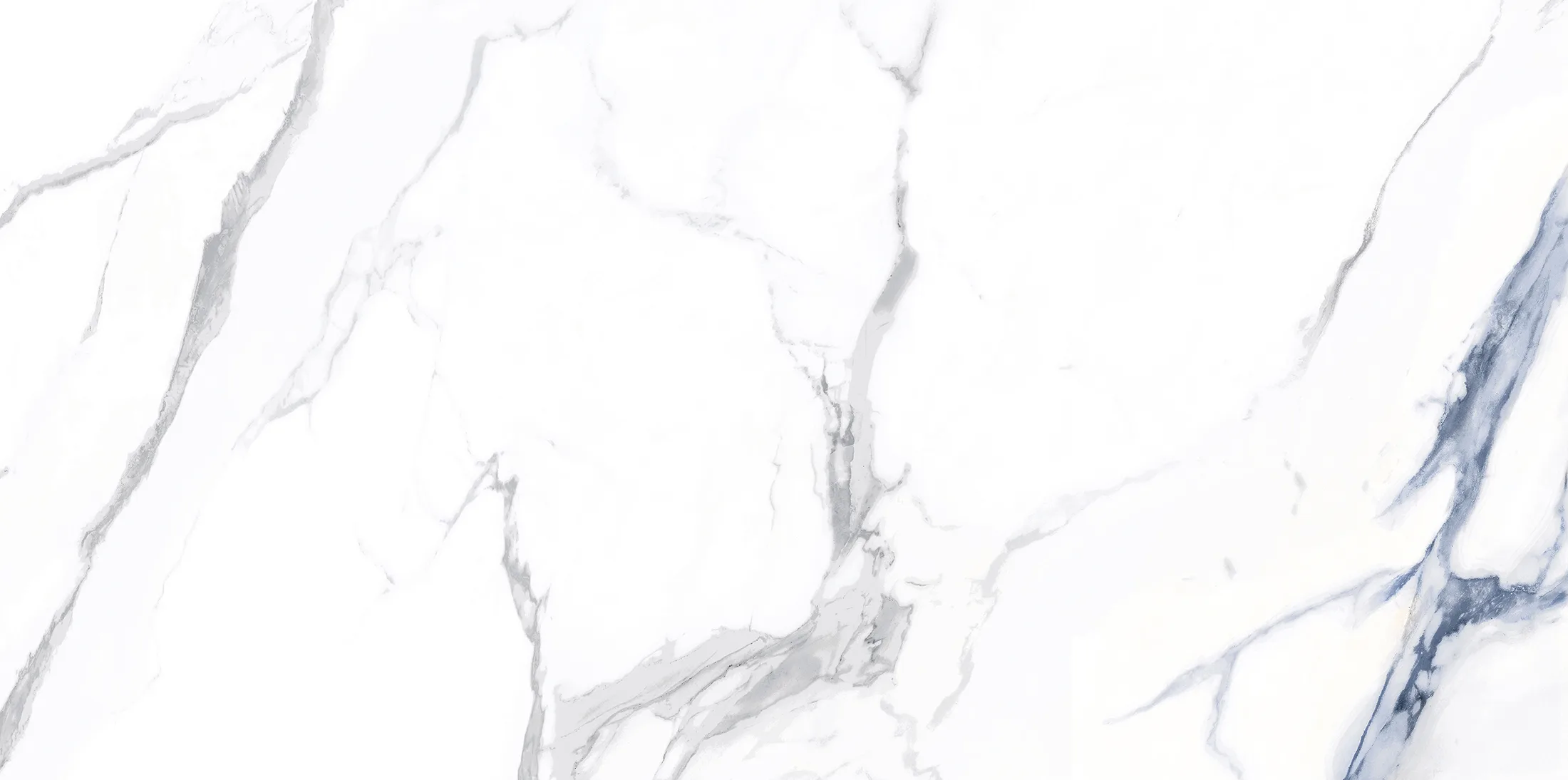
Slabs give the most seamless result, but they bring crates, lifting frames and specialist crews. The 80 × 160 cm (800 × 1600 mm) tile is the compromise many designers settle on. It covers 1.28 square metres in one piece, which is enough to change the look of a floor, but it is still something two installers can handle with the right gear.
The specification
At Lumina Tile, 80 × 160 cm is part of the Porcelain Floor Tiles category, in 8, 9, 10 and 12 mm thickness. The available surfaces are Glossy, Matt and Carving. It is a 1:2 rectangle, which means it can be laid in a brick pattern, a stack, or even a herringbone for a bold feature.
Why a 1:2 rectangle helps
A square is still. A rectangle has direction. At 80 × 160 cm, you can lay tiles lengthwise to draw the eye through a corridor or toward a window, or across the room to widen it. The format also divides neatly: two 80 × 80 cm squares equal one tile, so you can combine this tile with an 80 × 80 cm tile in the same design for borders and thresholds.
Floor or wall
| Use | Thickness | Surface | Note |
|---|---|---|---|
| Residential floor | 9 or 10 mm | Matt or Carving | Flat substrate essential |
| Commercial floor | 12 mm | Matt | Better impact tolerance |
| Interior wall | 8 or 9 mm | Any | Check fixing for weight |
| Kitchen worktop or island | 12 mm | Matt or Glossy | Use a fabricator |
Layout and installation
Layout: avoiding the usual problems
Long rectangular tiles can bow slightly along their length. A half offset places the bowed middle of one tile against the lower end of its neighbour, producing visible lippage. Use an offset of about one third, or a stack layout, and use a levelling system. A good installer will also check each tile with a straightedge before it goes down.
Plan the first row from the room's focal line, not just from a wall. Walls are rarely straight, and a floor aligned to a crooked wall will look worse than one aligned to a doorway or a window.
Handling and installation
- Carry on edge, never flat. A flat, unsupported tile of this size can crack under its own weight.
- Use vacuum lifters for placing tiles on a bed of adhesive.
- Comb adhesive in both directions and on the tile back, then press and slide to collapse the ridges.
- Cut with a wet saw or bridge saw that has a long enough bed.
- Leave movement joints at the perimeter and in large areas.
Underfloor heating suits porcelain, but ask the heating supplier for a screed and adhesive specification for large tiles.
Choosing and planning
Where it sits in the range
If you want more drama, 120 × 120 and 120 × 180 cm tiles go further, as do the slabs in the large slab range. If you want a lower-risk option, 60 × 120 cm is easier to handle and ship. The 80 × 160 cm tile is a good middle: dramatic enough for a feature, practical enough for a distributor to stock in volume.
Planning your order
Measure the room and run a layout on paper to see where cuts fall. Use the tiles calculator for a first quantity, and add extra for the stagger waste of long tiles. Check the packaging details to see how this size is packed and how many square metres fit in a container. Large tiles ship in crates, so check access and forklift availability at the destination.
Pattern ideas
Laid in a one-third offset along a corridor, the tile creates a long, calm line that leads the eye. In an open-plan room, a stack layout with matching grout looks architectural and modern. For a feature wall behind a bed or sofa, a vertical stack with tight joints gives a tall, clean panel. If you want a bolder floor, a herringbone with 80 × 160 cm tiles is possible, but it needs very accurate cutting and a high allowance for waste, so it suits showrooms and hospitality spaces more than family homes.
Common questions
Is 80 × 160 cm a good size for small rooms?
Not usually. Cuts at the edges become very visible. A smaller module is better for compact rooms.
Does it need a rectified edge?
For tight joints, yes. Ask about the edge on the design you choose.
How is it different from a slab?
It is a porcelain tile, supplied in the standard floor thicknesses, and does not need the lifting frames and crating that full slabs usually require.
To compare 80 × 160 cm with other large formats for your project, send your room plans to Lumina Tile via the contact page.