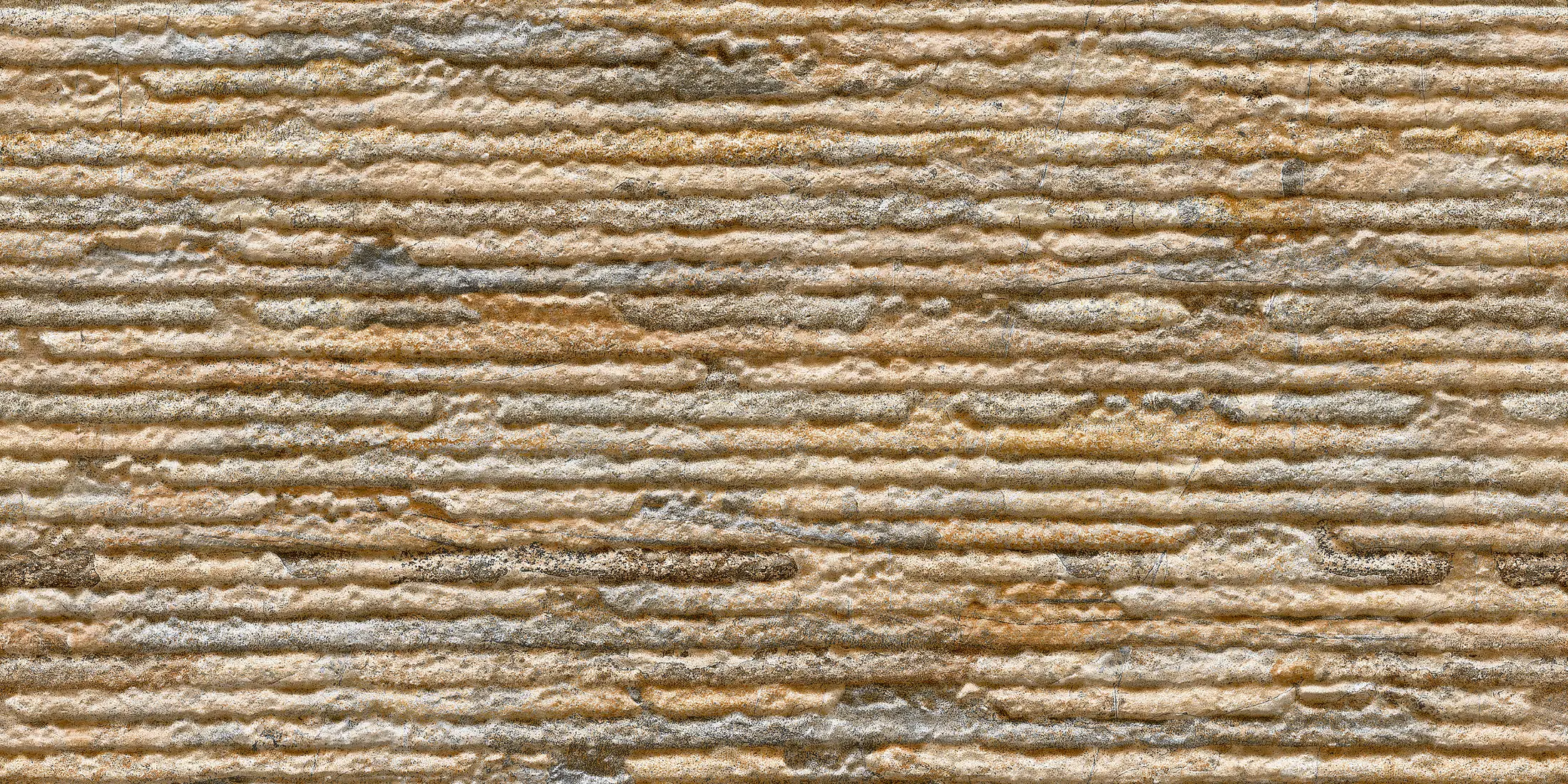
A flat tile gives you a clean plane and lets the printed design do the work. A 3D tile adds physical relief, so the wall catches light and throws shadow. The choice affects how a room looks at different times of day, how easy it is to clean and how hard the installer has to work.
What counts as a 3D tile
The term covers any tile with a moulded or pressed relief: waves, ribs, hexagonal facets, geometric peaks or sculpted floral shapes. Most are wall tiles in ceramic or porcelain. The relief is physical, not just a printed illusion, and it can be glossy, matt or a mix of both.
A flat tile has a level surface. It can still carry a rich design, such as marble, wood, concrete or pattern, but the effect is visual only.
Side-by-side
| Factor | 3D tile | Flat tile |
|---|---|---|
| Visual effect | Depth, shadow, changes with light | Even, calm, consistent |
| Best placement | Feature wall, headboard, reception, bar front | Whole rooms, floors, wet areas |
| Cleaning | Harder, dust sits in recesses | Easy wipe |
| Installation | Slower, needs careful alignment and grouting | Standard |
| Floor use | Not suitable | Suitable if rated for floors |
| Cutting waste | Higher, because patterns must align | Lower |
| Cost | Higher per square metre in most ranges | Lower |
How light changes the result
A 3D wall looks different at nine in the morning and nine at night. Side light from a window or a wall washer creates strong shadow lines and makes the relief the star. Overhead downlights tend to flatten it. If you plan a 3D feature wall, put linear lighting near the surface or use directional spots.
Flat tiles do not depend on lighting in the same way. A well-printed marble or wood design looks consistent from every angle.
Where 3D works indoors
- A single feature wall in a living room or hotel lobby.
- Behind a bed, a reception desk or a bar counter.
- Shop interiors and restaurants, where the wall is a brand statement.
- Staircase walls, where raking light shows the relief well.
Avoid it in splash zones such as shower walls and kitchen backsplashes, where grease and soap film settle in the grooves and are hard to remove.
Where flat wins
Flat tiles suit floors, wet rooms, kitchens and any space that must be cleaned daily. They also let you pick large formats with minimal joints, such as 30 × 90 cm or 40 × 80 cm in the ceramic wall tile range. A flat design with a carved or textured surface is a cheaper way to get tactile interest without the cleaning problem.
Lumina Tile's ceramic wall range includes Glossy, Matt and in some sizes Carving surfaces, giving you light texture with a flat profile. See ceramic wall tiles to compare what is available, or browse all designs for inspiration before deciding.
Installation notes
For 3D tiles, check that the substrate is flat, because relief exaggerates any wall irregularity. Ask the tiler to dry-lay the first rows to confirm pattern alignment. Use a flexible adhesive suitable for the tile weight, and a grout that can be pushed into the recesses without leaving voids. Allow extra tiles for breakage, because moulded edges are more fragile than flat edges.
Sound is a small but real benefit of relief tiles. A textured wall breaks up reflected sound and can reduce echo slightly in a hard, empty room such as a restaurant or lobby. It is not a substitute for acoustic treatment, but it helps at the margin.
For import buyers, packing deserves attention. Relief tiles have fragile raised edges, so cartons need good internal protection and a sensible stacking limit in the container. Ask how the specific design is packed, and allow a slightly higher breakage margin than for flat tiles. Order a spare allowance up front, because matching a moulded pattern from a later production run can be difficult.
If a fully moulded 3D tile is not right for the budget or the cleaning regime, a flat tile with a Carving surface gives a restrained version of the same idea. Lumina Tile lists Carving in ceramic wall tiles at 30 × 60 cm and in several porcelain and slab sizes. The texture is felt more than seen, and cleaning stays simple. It is a good middle path for hotels and cafes that want a tactile wall without deep grooves to maintain.
Common questions
Can 3D tiles be used on floors?
No. Raised relief is a trip hazard and wears quickly under foot traffic. Use textured floor tiles with a proper slip rating instead.
Are 3D tiles harder to maintain?
Yes. A soft brush or vacuum with a brush head is needed for dust. A feature wall in a dry room is manageable.
Can I mix 3D and flat?
Often it is the best approach: a 3D accent panel inside a flat wall in the same colour.
Tell us the room and the look you want via our contact page and we will suggest suitable wall tile options.