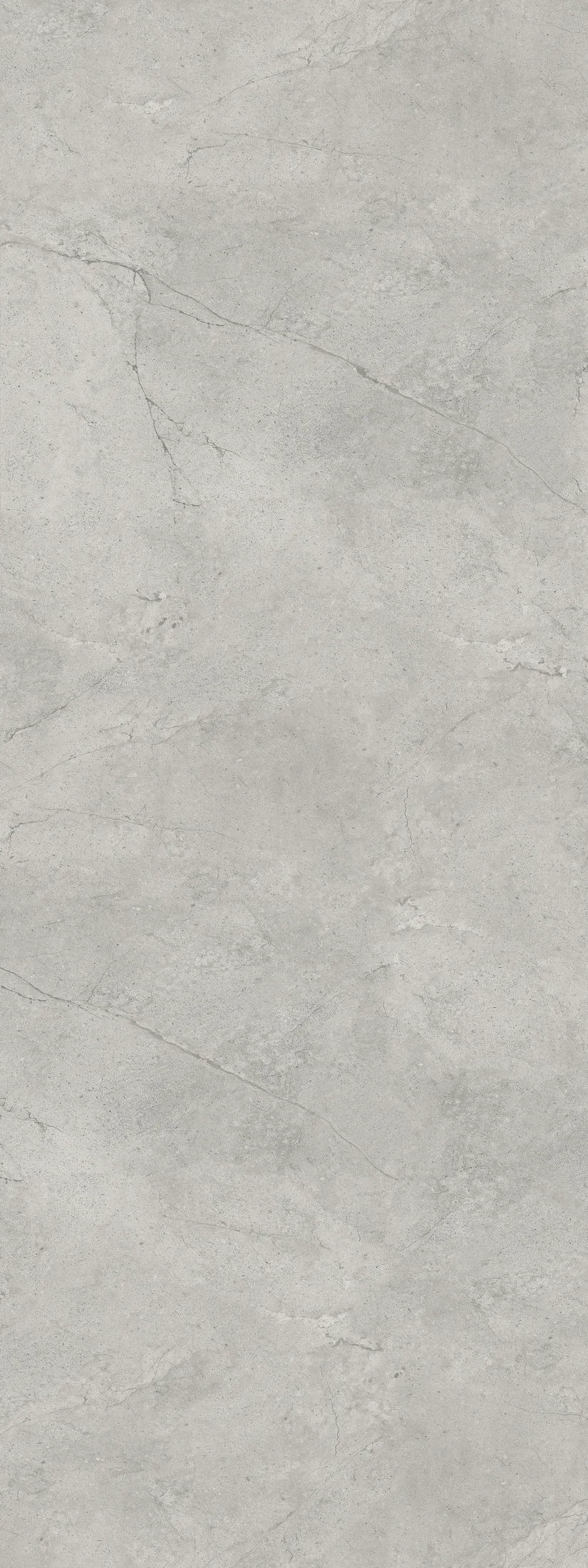
A 160 × 320 cm (1600 × 3200 mm) slab covers over five square metres in one piece. It is the largest format Lumina Tile lists, and it behaves more like a sheet of stone than a tile. Used where it fits, it can transform a space. Used where it does not, it becomes a logistics problem that costs more than it saves.
The specification
This size is part of the Large Slab Tiles category, offered in 6, 9, 12, 15 and 20 mm thickness. The surfaces listed for 160 × 320 cm are Glossy, Matt, Carving and Satin. Satin is a soft, low-sheen finish between gloss and matt, and it is specific to this largest format in the chart.
Slabs this size are almost always specified at the thinner end for walls and at 9 to 12 mm for any surface that bears load. Confirm the thickness for your chosen design at enquiry, since not every design exists in every thickness.
Where the scale pays off
- Feature walls in hotels, showrooms and lobbies, where a single slab removes all joints from a visual focus.
- Kitchen islands and worktops, where one piece can form a seamless waterfall from top to side.
- Large shower and spa walls, where fewer joints mean fewer places for water and mould.
- Retail and branded interiors, where a controlled, premium look matters.
It does not pay off in a small apartment, a narrow stairwell or a building without lift access. A slab that cannot reach the room is of no use.
Slab versus a smaller format
| Factor | 160 × 320 cm slab | 60 × 120 cm tile |
|---|---|---|
| Joints | Almost none | Regular grid |
| Installation | Specialist team, lifting frame | Standard tiler |
| Access needed | Wide doors, lift or crane | Normal |
| Waste on cuts | High if room not planned | Low |
| Look | Seamless, architectural | Familiar, flexible |
Installing a slab
Handling and site logistics
Plan this as a lifting operation, not as a tiling job.
- Survey the route. Measure every door, corridor, lift and turn between the delivery vehicle and the room. A 3.2 m slab travels on edge, so check ceiling heights on stair landings too.
- Agree the lifting method. Slabs are moved with A-frames, trolleys and vacuum lifters. Some sites need a crane or a hoist through a window or void.
- Store correctly. Keep slabs upright on a flat, protected surface, supported along the length. Never stack flat without proper support.
- Cut with the right tools. A bridge saw or CNC cutter gives clean cut-outs. Plan the cut-out locations before the slab arrives, and keep them away from edges.
The packaging details describe how large slabs are crated for export. Container planning is different from regular tile: fewer square metres fit, because slabs are packed on edge in crates.
Substrate and fixing
Thin slabs require an absolutely flat, fully supported base. Fix with a suitable adhesive, applied to both substrate and slab back with a notched trowel, and use mechanical pull-handles or vacuum lifters to set them. For wall cladding at height, discuss mechanical fixings or a ventilated facade system with your engineer. Do not rely only on adhesive for overhead or exterior use.
Movement joints are still required at perimeters and structural joints. A seamless look does not mean a rigid one.
Choosing the surface
For walls, any surface works, and gloss gives a dramatic look. For worktops, matt or satin resist scratches and fingerprints better. Carving gives a tactile feature wall, but it is harder to wipe. Whatever you choose, request the technical data on the technical details page.
Budgeting the whole job, not only the slab
With a format this large, the surrounding work is a significant part of the project. Allow for specialist installers, lifting equipment, crating and a higher breakage allowance. Order at least one spare slab from the same batch, because a replacement from a later production run may differ in shade or surface. Agree in writing who inspects the crates on arrival, and photograph any damage before the slabs leave the delivery vehicle.
Finally, confirm the sequence of trades. Slabs should arrive after wet work is finished and the site is clean, and they should be installed before heavy fit-out follows. A slab left in a busy corridor for weeks is a slab at risk.
Common questions
Can a 160 × 320 cm slab be cut into smaller pieces?
Yes. Many projects buy the slab to cut it to size for worktops, vanities or panels.
Is it suitable for floors?
It can be, in a thicker option and a specialist installation, but most buyers use this size for walls and surfaces.
Where can I see the full slab range?
The large slab range lists every slab design and size.
Before committing to a slab project, send Lumina Tile your drawings and site access details via the contact page, so thickness, crating and shipping can be planned together.